Saturday, February 14, 2004

Conversation with Mohammed in Houston


> I am extraverted, and I love visiting new places and making new friends.  Beside those in my professional circle, I often befriended hotel staff and cabdrivers.  I was curious about their personal background, and relished their on-the-ground stories of the cities where they worked.  Unlike many of us, they were well positioned to see people from all walks of life.

Below are some bits from one of them, a gentleman from Somaliland, working in Houston (US).  It took awhile to wade through the accent of his English. <

(image credit)

Mohammed

Mohammed is a cabdriver who took me from Intercontinental Airport in Houston to our consulting office, and he hails from the Republic of Somaliland.  “Somalia?” I had to ask, because I didn’t quite understand what he said. “Republic of Somaliland.”

I saw that he had a book titled Islam on the floor next to his seat. I asked him if he was Saudi, and I believe he said, "No."  But I didn’t understand him, at the moment.  Because when he said that his home country was close to the Red Sea, I asked “Western Province [i.e., of Saudi Arabia]?”  "No," he said, “We’re on the other side of the Red Sea.” And I tried to picture my globe at home, and I couldn’t place Somaliland.  I then acknowledged “Ah, Africa.” 

His story

He rattled on for several minutes, some of which I picked up:

He’s been living in Houston about nine years, but wants to return home in about three years.

His major in college was History, but apparently he studied (or maybe tried to study) Manufacturing or Engineering in the US.

He has a brother in Houston, who’s a congressman.

He said it was very cheap in Somaliland, and they have various hotels that we Americans were familiar with, e.g., Embassy Suites and Sheraton.

Western Africa is very beautiful, but also very corrupt. “They love corruption there,” from the president to the civil people. “They proud of it, too.”   Nigeria is an example; I mentioned to him that I had a friend who was Nigerian.

He referenced Joseph Estrada, the former movie star President of the Philippines. He’d never visited the Philippines, but he knew it was made up of islands.  Over 7000, in fact.

> Notes
Ron Villejo, PhD
January 2013 <

Saturday, May 10, 2003

Tour of Bahrain


> The luxurious Ritz-Carlton in the Seef District of Bahrain is the hotel where I have stayed the greatest number of nights, from 2003 to 2006, among all the hotels I have stayed at around the world.  I estimated it to be about six months in total. <

Today was an outing with the gents, the members of my client project team:  Charles, Per, Dale and Herdie.  We took a ride with Ghadeer Tours, with Abdulla, as our tour guide, an articulate, handsome Arab man.

An Iraqi Woman

A woman, Nelly, married to an Ericsson businessman was with us. She is an Iraqi, of Assyrian descent, and now lives with her husband in Sweden. She speaks English, Arabic, Swedish, and Assyrian. Her brother lives in northern Baghdad, and she was worried and angry at the war. Thankfully, it was an area that was not heavily bombed by the Americas. She has not had direct communication with him (because of damaged communication infrastructure), but understands from her nephew, her brother’s son who lives in Sweden as well, and from relatives in Canada that her brother is OK. The UN sanctions against Iraq apparently impoverished many Iraqis, and her brother in particular has had difficulty finding a job. Because of this impoverishment, she said, “This stealing, I understand.” She does acknowledge, though, the loss of historical artifacts is a shame.

When Abdulla mentioned that Bahrainis wondered if the area around the Tree of Life was the Biblical “Garden of Eden,” she quickly retorted that it was in Iraq. There is a tree where the Euphrates River meets the Tigris River, and this is the “Garden of Eden.”

Al Jasra Handicraft Center

(image credit)

One man was a painter, musician and craftsman. He made his own musical instruments, with influences, he said, from Arabia and Africa. Tamboora is a string instrument. Manjor is a percussion type made of goat’s nails, tied together in strings that hang on cloth, then worn like an apron around the waist, and shaken.

Another man builds boats. Here at the Handicraft Center, he builds models of boats or ships (dhows). Those made of teak are more expensive and heavier, and those of mahogany are lighter. Herdie bought a mahogany one as a gift for his grandson.

A woman in a basket weaving shop sat inconspicuously on the floor, wearing her abaya fully, and working on a basket.

Heading toward the Desert

(image credit)

Jebel Al Dukhan (“Mountain of Smoke”) is the highest area in Bahrain above sea level, about 135 meters. Abdulla referred to it as our Himalayas.

Not far from there is the site where Frank Holmes, a New Zealander, first struck oil in the Gulf Region: June 1st 1932. When I visited this site last year, it had a few pieces of trash in this little oil well. Now, sadly, it had more… soft drink bottles, cigarette boxes, etc.

We headed to the Tree of Life, that oh, so, venerable tree, that also was not well taken care of. Last year, there were people milling about. There was graffiti on the tree. Someone had a tent, and may have sold rugs. Across the desert area were people racing their cars. It was a shame! It is a mesquite that has outlived other trees in its species (typically 100 years) by about 300 years. Its bark looks like the wrinkled leathery skin of old men, and it is this very texture and its age that afford it its venerability. Now, it looks like there was some attempt to wash out the graffiti, and there was not as much trash around it.

We passed the homes of the royal family: King Hamad; his uncle, Shaikh Khalifa, the Prime Minister; his son, Shaikh Salman, the Crown Prince. These three men are often pictured in Bahrain venues, including the Ritz-Carlton, with King Hamad father, Shaikh Khalifa’s brother, Shaikh Isa, also pictured, in this order from left to right: Shaikh Salman, Shaikh Khalifa, King Hamad, and Shaikh Isa.

Bahrain produces about 250K barrels of oil a day, and about 300 million cubic feet of gas. Yokojawa designed some of its gas wells, and constructed by Schlumberger.

Grand Mosque (Al Fatih)


(image credit)

With my comrades, I finally had a chance to visit this Mosque, after wanting so for the past year. It was very good to have Abdulla with us, because he not only gave us guidance about the mosque, but also served as our liaison with various Arab staff there. We took off our shoes. Per who was wearing shorts had to wear a jabeel (sp?), a thobe of sorts with short sleeves and extending in length to the ankles. Nelly had to wear a black garment, which I suppose is an abaya, and a scarf to cover her head. Abdulla explained that virtually every part of a woman is considered “sexy” and thus must be covered. Men also have to cover parts of their bodies, but they can wear slacks that run at least to the knees, so lengthy walking shorts would be fine. Well, apparently they have fewer parts of their bodies that are sexy.

The Mosque has materials that came from different parts of the world:
  • Marble from Italy
  • Carpeting donated from Scotland
  • Chandeliers from France
  • Teak doors from India
Muslims must pray five times a day:
  • Fajr.  Early morning, when the light first appears on the horizon, apparently as early as 3 AM.
  • Dhuhr.  Noon, when the sun is vertical (straight up).
  • Asr.  Afternoon, when the object and its shadow are equal.
  • Maghrib.  Evening, first few minutes after sunset.
  • Isha.  Night, when there is no longer any red in the sky.
It is important for Muslims to have regular connections to God everyday. God understands that for most of the day, they can focus on their work, their daily lives, etc. But for these five prayers, they need to say passages from the Qur’an to connect to God. Now, I know from some of the managers we worked with, that the morning and afternoon prayers can be combined with the noon one. Abdulla said Muslims must get up and pray that morning time, yes, even as early as 3 AM. But, just as some orthodox Jews find opportunities for flexibility on the Sabbath, some Muslims may similarly do so with prayer times.

Bahrain National Museum

(image credit)

Muslim astronomers divide the year into six seasons: early autumn, late autumn, winter, spring, early summer, and late summer. The Islamic year is a lunar year of 12 months, with each one having 29 or 30 days, totaling about 354 days (about 11 days shorter than the solar year). It repeats itself every 31 years. This calendar began in 622 AD, during the flight of the Prophet Mohammed (PBUH) to Madina. Thus, the moon determines the years and months, and the sun determines the hours, seasons, and hence prayer times.

Here are the historical eras of Bahrain:
  • Stone Age (5000 BC – 3200 BC).
  • Formative Dilmun (3200 BC – 2200 BC). Long distance trading began, with ships sailing from one port to another.
  • Early Dilmun (2200 BC – 1600 BC).
  • Middle Dilmun (1600 BC – 1000 BC). Nomadic tribesman from the Iranian highlands, Kassites, took rulership of Dilmun and apparently made it into one of their provinces. These rulers, Kings of Babylon, built city walls and massive stone storehouses. Now, I believe the region that was Mesopotamia is now called Iraq and Iran.
  • Late Dilmun (1000 BC – 330 BC). Independent kings ruled Bahrain, perhaps Arabic.
  • Tylos (330 BC – 622 AD). Greek influence pervaded the Gulf Region, as Alexander the Great “passed like a comet,” smashing the Persian Empire in the lands north of Bahrain. Apparently he never invaded Bahrain, but had plans to do so before he died. Bahrain, at this time, was known for its prosperity and connections with the Islamic culture. But the name Dilmun probably involved into Thilwun, then was Hellenized to Tylos.
  • Early Islam (622 AD). In 629 AD, the Prophet Mohammed had a letter sent to the ruler of Bahrain, Al Munthir bin Sawa Al Tamimi, to accept Islam: “There is no God, save Allah…” He said to forgive those who have sinned, as long as they convert to Islam.
  • Middle Islam. Trade was active in East India and China. During this time, various rulers from Iran, Oman, and Portugal had sovereignty over Bahrain, with the Portuguese for about 100 years.
Some information on the culture and industry:  Pearl diving was big in the first part of the 20th century. Divers would dive from June to October, had themselves tethered with ropes to their ship, and went down 7 – 20 meters to get to the “sweet water springs.” They were under water for 1 – 2 minutes. At one point, there were up to 2500 ships for pearl diving.

Pearls were measured according to brilliance and clarity, with the following in descending order of quality:
  • Jiwan
  • Yaka
  • Qolo
  • Badleh 
Both men and women were involved in weaving. They would import cotton, gold, and silver threads.
Bahrain is called a country of two seas: fresh and salt. It is also a country called “Land of a Million Date Palm Trees.” These trees were a treasure trove of uses:
  • Dates for food
  • Trunks and branches for houses and boats
  • Leaves for mats, fans, and baskets
  • Fibers for ropes
“The Children go to the Sea.” 

On the 9th day of the Dhu’l Hija, the pilgrims pray at Arafat. In the meantime, children go to the sea, singing Hiya Biya, and throw baskets of green sprouts and cereals (hiya) to the sea. For toys, they families make them, for instances, dolls from bird bones and clothed with available fabrics.

> Notes
Ron Villejo, PhD
December 2012 <

Sunday, December 22, 2002

Conversation with Nabil on KLM


I met another gentleman on the flight home from Amsterdam to Chicago, Nabil, a General Manager at Al-Yubr, located in Jubail, Saudi Arabia:

He is of Palestinian descent. Married an ex-pat, American teacher, and they lived in the Middle East about 18 years together. She decided to move back to the US not too long ago.

They have four or five children, ages 18 to 30, most of whom are out of college. They went to college in the Midwest: Purdue, Iowa, and Evansville.

He was heading to the US to celebrate Christmas and the holidays with his family. One daughter was to pick him up from the airport. She lives in Matteson, IL, apparently with her mother as well. They were going to travel together first to Atlanta, then to Florida, where they will actually celebrate Christmas.

He said Al-Yubr is about a 2200-employee company, doing contracting, oil field maintenance (I believe), and other industry services. He said Saudization is a failure, citing that approximately 50% of his company are Filipinos.

He mentioned that having Saudi Aramco on your client list opens doors to other companies. He mentioned SABIC (Saudi Arabian Basic Industries), which PDI already has contacts with and in fact has a big opportunity with.

In my recent efforts now to network, I was very pleased to make the acquaintance of both Azer and Nabil.

> Fortunately I find it easy to talk with people and make friends.  I listen well, and keep track of conversation.  I had a number of such wonderful conversations with a friend, while visiting him in Stockholm, that he came to understand my need to "download" after each one.  That is, I don't take notes, but can remember the conversation really well, as long as I get to my laptop and tap out notes on my journal.

Notes
Ron Villejo, PhD
November 2012 <

Sunday, December 15, 2002

Conversation with Azher on KLM


I was in our dormitory, Steineke Hall, at our client's HQ in Saudi Arabia, recounting the bits and pieces of conversation I had, miles in the air, just two days before. 

Steineke Hall

I met a gentleman named Azher, onboard the KLM flight from Amsterdam to Dammam this past Friday. He looked to be a quiet Middle Eastern man. And me, because I am shy underneath it all, I kept quiet as well for much of the trip. He was actually the one who broke the silence between us. As I prepared for my first two days of client meetings, he remarked “Have a lot of work, too?” He had documents and files in front of him as well.

At issue 

We shared the work that we do, our families, and also talked about some of key circumstances surrounding the Middle East: 

The fact that the majority of the September 11th hijackers were Saudis, and concerns about money within the country having been funneled to the hijackers.

The threat of war against Iraq, and my hope that it never breaks out and that the US ultimately addresses what appears to be key causes to terrorism: poverty and lack of business investment in less fortunate countries in the world.

Our client having been very gracious and receptive to working with Americans on their leadership development. We take care to steer away from potentially sensitive, political issues.

The ambivalent, complex relationship between Saudi Arabia and the US., especially as it relates to the Israel-Palestine conflict and the demand for oil.

His business

Runs his own textile company out of Indianapolis, IN, with 56 employees, and apparently serves customers in the Middle East and Europe.

They supply washcloths and linens, I believe, to customers in the hotel, hospital, and laundry industries.

He mentioned that he was traveling right now to the Middle East to address a quality problem with a supply chain partner. Apparently the packaging of their product and the quality control measures in this region are not meeting standards (e.g., loose threads are not being snipped).

The downturn in the economy has in fact impacted them: e.g., because there are fewer travelers, hotels have less need for washcloths and linens.

His family

Has three teenage adolescents, the eldest of whom is a daughter who has requested an arranged marriage. He is Pakistani, and he and his wife met through a similar process in Pakistan. He (and his wife, I imagine) apparently offered their eldest a choice.

Because of travels, he works to focus on quality of time with his family. For example, during the World Cup in Korea, he and his son traveled there together to watch soccer games. He and another daughter traveled together to San Diego (I cannot remember for what).

He and his family just finished observing Ramadan. He traveled during this month-long observation, but apparently kept it to some minimum.

I mentioned our efforts to accommodate prayer times in our work with Saudi Aramco. There are five times: sunrise, midday, mid-afternoon, sunset, and midnight. And Arab folks can combine two of them into one, especially when they are traveling.

> I mistakenly thought Azher was Middle Eastern.  As a Pakistani, he's Asian.  Three months after this journal entry, in March 2003, the US was at war in Iraq (sigh).

Notes
Ron Villejo, PhD
November 2012 <

Tuesday, March 12, 2002

Venerable Tree of Life


> I kept a Word journal of my journeys to the Middle East, and thought I had lost it for good, when I couldn't find it.  But sometimes things have a way of reappearing, just when we aren't looking.  So there it was, yesterday, in one of my folders.

You may know that the earth's crust is made up of plates.  Its spherical surface is far from smooth, more like a soccer ball with uneven sections than a perfectly seamless beach ball.  These jagged plates lean, and press against each other at the edges with great pressure.  By and large the opposing forces create an equilibrium, but on occasion there is slippage, way deep under ocean waters.  The resulting force is so great, as to cause a horribly destructive tsunami. 

The earth's crust, and its behavior, are called plate tectonics.

I use the word 'tectonic' to mean something momentous.  My journeys to the Middle East are tectonic.  A life-changer in ways I could've never imagined.

Here is the very first entry in that journal, on March 12th 2002.  It was Tuesday morning, and I was en route back home aboard KLM Royal Dutch, from Amsterdam and Chicago, after our first fateful trip to Bahrain. <

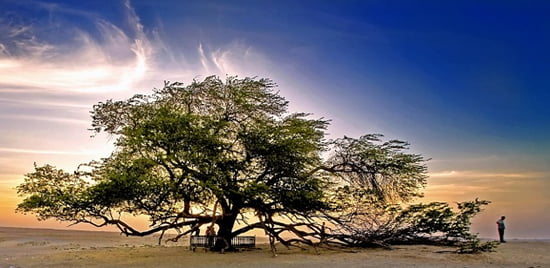
Tree of Life, in Bahrain.  Photo, by Faisal Ansari.

What did I do to learn about Bahrain?

I visited the Bahrain National Museum on Thursday afternoon, March 7th. The taxi driver who took me there - an Omani gentleman named Rashid - also took me back to the hotel, and clearly appreciated the fact that I called him specifically to do so.  I arranged for Rashid to take on a tour toward southern Bahrain. He first took me to the Bahrain fort. Then our route to the Oil Museum passed by the mansion of the Al Khalifa royal family. The museum sits off the Jabal al Dukhan, the highest elevation in Bahrain (not very high), and right besides it, the location of the very first oil well.  Bahrain was the first Arab country to discover oil (1932).

Then, the Tree of Life.

It was described as a tree that defied the odds of nature.  Living about 400 years, when the tree is expected to live about 100 years. Living in the desert environment, where its exact water source is still a mystery. The descriptions suggested that the tree commanded reverence from people. 

So I was terribly disappointed when I visited and it was hardly protected from the abuses of people. It had graffiti on it, for God’s sake! There was no surrounding barrier really. There was a banner on it. There was trash in the surrounding area. And there was drag strip racing in the desert, when one guidebook indicated the need to respect the desert. Moreover, the tree’s bark looked like the skin of an elder person and was very much part of the reverence it commanded. Unfortunately, because it was not well taken care of, it looked like it was dying. The bottom part of the tree had relatively few leaves and the top part had leaves that did not look healthy.

> I remember, too, that a horizontal branch had grown so long and so big it was virtually laying on the desert surface.  The photo above doesn't quite depict it, but it was as if this venerable tree had placed a gnarled elbow on the ground to support the weight of that branch.  Imagine yourself thinking at your desk, chin on your palm and your elbow on the desk.  

Imagine sitting at your desk for 400 years.  

Notes
Ron Villejo, PhD
November 2012 <